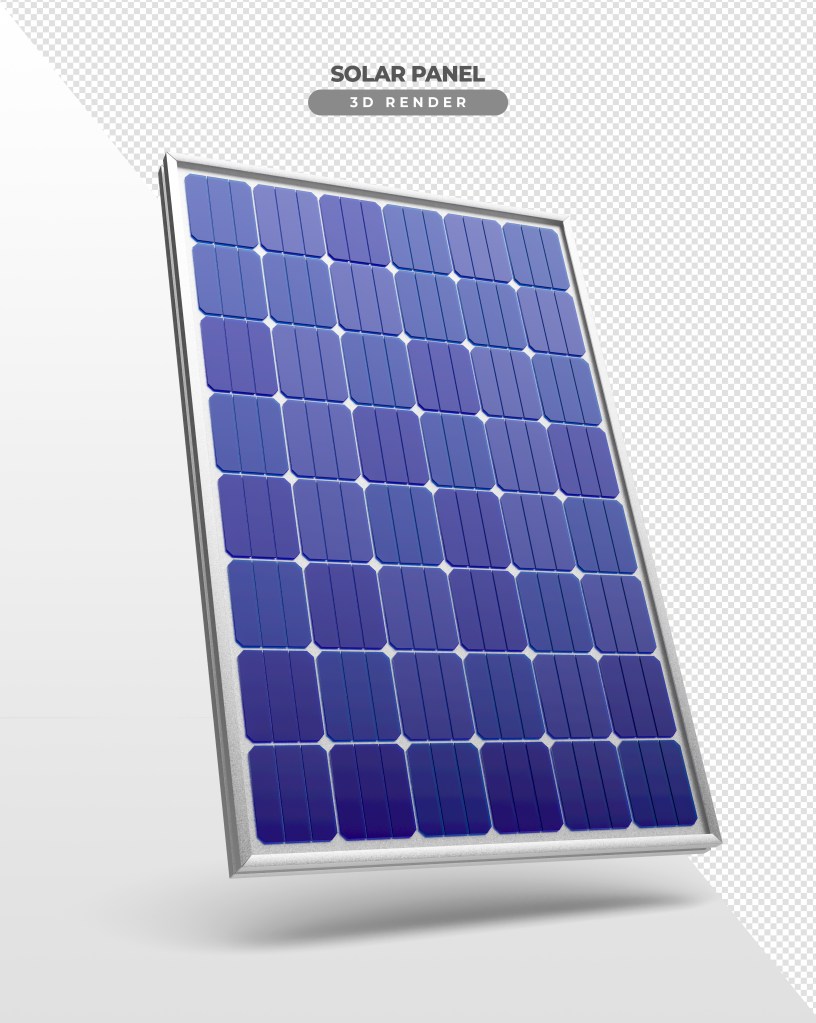
You might have seen them — those dark blue or black rectangles on rooftops in Mountain House. Those are solar panels, and they produce electricity by turning sunlight into energy. This is one of the best examples how materials science works. Solar panels have no moving parts and do not need any fuel. They are simply layers of materials stacked one upon another, like a sandwich, that absorb energy from the Sun. But what exactly does this “sandwich” do – and why is it important?
It All Starts with Silicon
The heart of a solar panel is silicon — the stuff that beach sand is made of, and the second most abundant element on Earth after oxygen. But silicon has a special property: it is a semiconductor, which means it is not quite a conductor (like metal) and not quite an insulator (like rubber). This in-between property allows us to manipulate the conductivity through silicon, either increasing or decreasing it by a process called doping. To make solar panels, scientists take raw silicon, purify it and then slice it into paper-thin wafers. Each wafer becomes one solar cell. By connecting many of these cells together, a solar panel is created.
The Photovoltaic Effect: Light Knocking Electrons Loose
Solar cells are built in two layers, like a sandwich – a layer with extra electrons (called the Negative or N-Layer) and a layer that is missing electrons (called the Positive or P-Layer). We can do this because silicon is a semiconductor! The boundary where these two layers meet (called a P/N Junction) is where electrons can wander between layers, and this movement creates an electric field at the boundary. A field is simply a sphere of influence that exists around every particle with charge, such as electrons. A property of the electric field is that it exerts a force on any other electrons in that sphere of influence. When sunlight hits a silicon atom at the P/N junction, photons (tiny packets of light energy) knock electrons loose from these atoms. Normally those electrons would just wander around randomly. But the presence of the electric fields at this junction forces all these loose electrons to move in a single direction from the positive layer to the negative layer, creating electric current. Scientists call this the photovoltaic effect — “photo” for light, “voltaic” for electricity.
The Other Layers: Glass, Metal, and Anti-Reflective Coatings
Silicon is the star of the solar panel, but it needs help from other materials. The top of a solar panel is covered in tempered glass — a specially treated glass to make it stronger. The glass protects the delicate cells from rain, hail, and other elements of weather that rooftops are exposed to. On top of the glass sits a thin anti-reflective coating. Without it, shiny silicon would reflect away more than a quarter of the sunlight before it could even be captured. The coating gives panels their dark blue or black look and helps them absorb as much light as possible. If you look closely at a solar panel, you will notice a grid of thin silver lines across its surface. These silver or aluminum metal contacts act like metallic highways, gathering the electric current produced by the cell and sending it out of the panel.
What About Efficiency?
Not all sunlight that hits a solar panel becomes electricity. Most home panels today convert about 20-22% of sunlight into usable power. Researchers are always experimenting with new materials to push efficiency higher. Some labs are testing panels made with a material called perovskite —cheaper to make than silicon with efficiencies over 25% in the lab. We may see these on newer homes within a decade!
Right Here in My Neighborhood
Solar panels are becoming more common in my community, indeed all across California, partly because they help reduce electricity costs and partly because they produce energy without burning fossil fuels. In sunny regions like the Central Valley where I live , solar panels can generate a significant amount of power simply by sitting in the sun for a few hours each day. Three silicon solar cells generate about 1.5 volts of electricity — as much as one AA battery. A typical home solar panel strings together 60 to 72 cells and a full rooftop array of panels can power an entire house. This is material science in action, working quietly to power our homes!