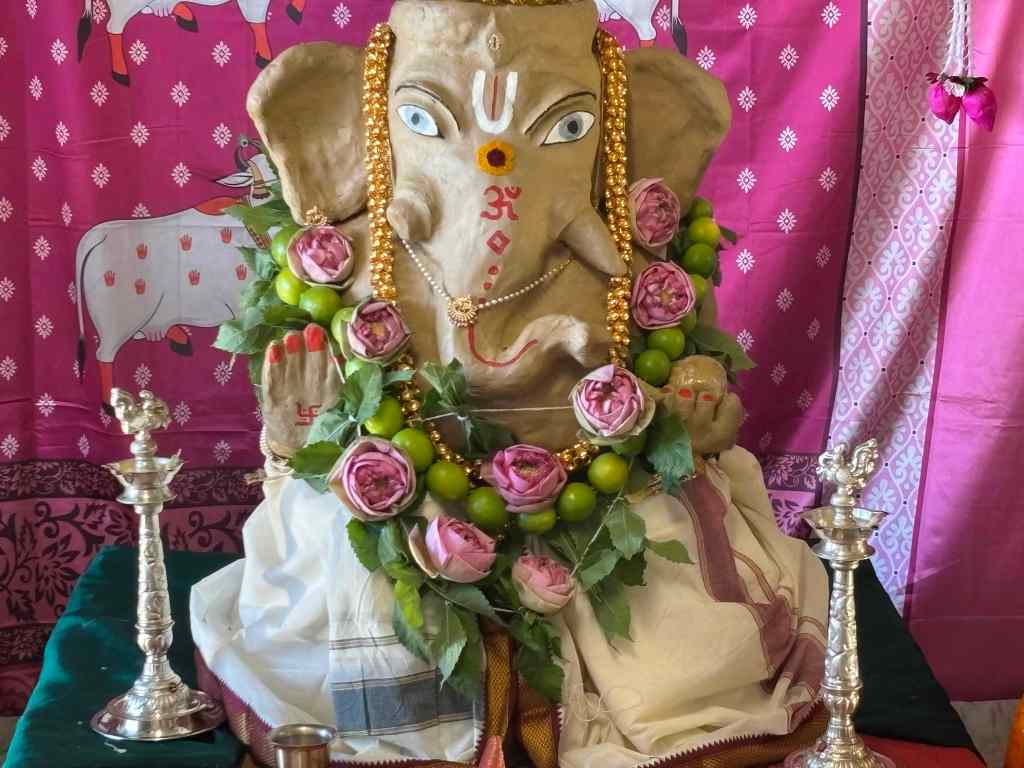
Every year in September, millions of families across India and the United States welcome Lord Ganesha into their homes as a clay or plaster idol, knowing that in seven or ten days, that same idol will be deliberately given back to water. It’s one of the only rituals in the world where an object is built with its own destruction as the goal. And this simple fact poses a materials science problem — one that looks a little different depending on whether you’re standing on the banks of the Godavari or filling a bucket in a backyard in Mountain House.
Two materials, one question: how should something fall apart?
For most of the 20th century, idol-makers used Plaster of Paris (PoP) — a manufactured material made by heating gypsum and grinding it into a fine powder. PoP has several advantages – it is cheaper and easier to mold into large but relatively lightweight idols. Traditional clay, by contrast is sourced from riverbeds, heavier, and more prone to cracking during production, which usually forces artisans to make idols smaller as a result.
But the more interesting materials-science story happens after the puja, when the idol meets water.
The chemistry of setting hard vs. falling apart
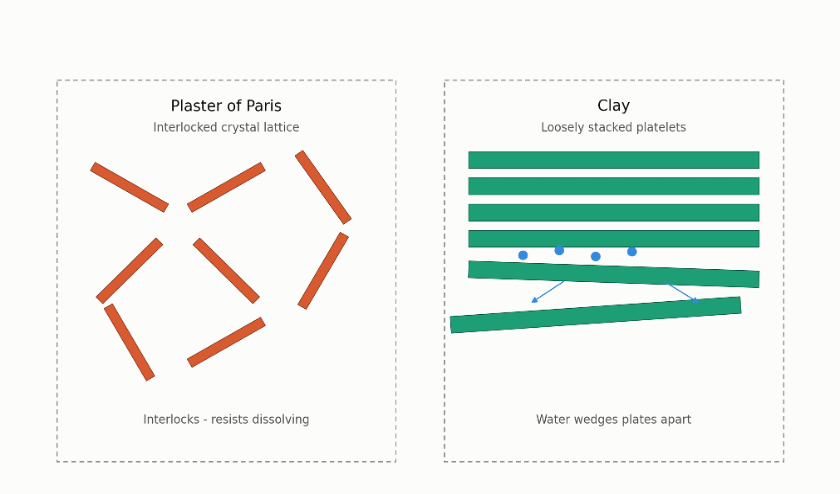
Plaster of Paris starts life as gypsum which is fired at low temperature to drive off most of its water, producing the actual powder you’d buy as “plaster.” When an idol-maker adds water back to that powder, an exothermic hydration reaction runs essentially in reverse: the material re-absorbs water and recrystallizes back into a dense, interlocking network of needle-like gypsum crystals. That interlocking crystal lattice is what makes a wet slurry of powder set into a hard, load-bearing solid within minutes — and this is exactly why it refuses to come back apart in a lake. Instead, PoP idols mostly break down through slow mechanical attrition — water erosion, currents, and physical disturbance gradually crumbling the crystal matrix into smaller and smaller solid fragments, which is why an idol can sit largely intact at the bottom of a lake for months.
Clay works on a completely different physical principle. Natural clay is made up of flat, plate-like particles typically just a few nanometers thick — and in a formed, dried idol, those platelets are held together mostly by weak electrostatic forces and capillary water bridges trapped between the plates. When the idol re-enters water, water molecules rapidly wedge between the clay platelets, screening the weak electrostatic attraction and collapsing the capillary bridges holding the structure together — a process materials scientists call deflocculation. Because there’s no crystalline lattice to mechanically grind down, just a physically loose stack of plates to pry apart, the whole idol can disperse back into suspended clay particles within roughly an hour.
Where binders and fibers complicate the picture
The challenge today is how to get the best of both worlds – the strength of PoP as well as the ability of clay to dissolve quickly. That is exactly the gap that eco-friendly idol composites try to close using additives such as guar gum binder and jute/coir fiber. Guar gum is a natural polysaccharide that, when hydrated, forms a tangled network of hydrogen-bonded chains threading between clay platelets — effectively adding a second, gentler adhesive layer on top of clay’s naturally weak particle bonding, which boosts green-body strength enough to survive sculpting and drying without cracking. But guar gum is itself water-soluble and swells readily on contact with water, so it doesn’t obviously slam the door on fast dissolution the way a true waterproof binder would.
Jute and coir fibers work through an entirely different mechanism — they reinforce mechanically rather than chemically, bridging microcracks and resisting pull-out the way rebar reinforces concrete. Because that reinforcement is mostly physical anchoring rather than a chemical seal, fibers could add meaningful strength without dramatically slowing dissolution
Why this isn’t just an academic question anymore
This trade-off has become urgent rather than theoretical. India’s Central Pollution Control Board revised its idol-immersion guidelines to ban plastic, thermocol, and Plaster of Paris outright, pushing instead for naturally occurring clay and mud.
The pollution case against PoP isn’t just about the material sitting inertly at the bottom of a lake, either. Chemical paints used to decorate PoP idols often contain heavy metals like mercury, cadmium, and lead, which leach into the water and harm aquatic life.
But here’s the catch nobody’s fully solved: clay idols are heavier, crack more easily during production, and have to be made smaller — all of which drives up their price. Banning PoP doesn’t automatically give artisans a material that works as well. It just removes the option that was working for them, even while working against the rivers.
In Mountain House and across California’s Central Valley more broadly, there usually isn’t a river, lake, or reservoir where a family can legally immerse an idol at all —families instead do “bucket visarjan”: submerging a clay idol in a large tub or bucket of water in the backyard, letting it dissolve over a few hours to a couple of days, then pouring the resulting clay-and-water mixture directly into garden beds or potted plants rather than into a storm drain.
A composite that keeps clay’s fast bucket-scale dissolution while surviving shipping from an idol-maker to a Central Valley driveway without cracking isn’t solving an abstract materials problem — it’s solving the exact one a Ganesha puja held locally actually runs into every single year.

What’s your take on this? Click below to leave a comment