I recently helped my uncle install a couple of floating shelves in our living room and that process got me thinking about how these shelves actually work. It looks magical, a heavy board just hanging off a wall in midair and blending into the room without anybody noticing. But there is a lot of engineering allows the shelf to support the heavy books or the potted plants without swaying or collapsing.
Hidden inside every floating shelf is a steel bracket, basically a bar that is used to attach to the wall on one end and then the shelf, which has holes drilled into the back slides into the bar. So the shelf isn’t holding itself up at all. The steel rods are doing the real work, and the wood is mostly there to look nice. The brackets themselves are made from a heavy yet lightweight metal that allows the weight of the shelf to press down and not pull out from the force pressing against it.
The obvious question to ask is why is steel specifically used in these brackets?
This comes down to a property called stiffness. It tells you how much a material resists bending or stretching when you push on it. When the shelf is attached to the wall and things are then placed on top of the shelf, almost all the stress piles up right where the shelf meets the wall and that’s where things break. So that is why the stifness of the materials that makes up the bracket is important.
Engineers measure stiffness of various materials with a number called Young’s modulus. Here are some rough numbers:
- Steel: about 200 GPa
- Solid wood (along the grain): about 10 GPa
- MDF (the cheap pressed-fiber board): about 3–4 GPa
Another thing engineers do to reduce stress is to avoid using wood with high density for the inner part of the shelf. A hollowed out inner part with some sort of girding in the middle gives the best trade off between strength and weight.
The other part of this equation is the wall itself. Most walls in houses are drywall, which is a layer of gypsum (a soft mineral) sandwiched between paper. Gypsum is not very stiff and can be crumbled with our fingers when we pull on it. So, if a shelf is attached to the gypsum of the dry wall the weight on the bracket will eventually pull a chunk of gypsum out of the wall and will bring the shelf down. That’s why every guide says to screw into the studs, the wooden beams behind the drywall. Wood holds screws better because its long fibers grip the threads of the screws. If there’s no stud where you want to install the shelf, special anchors that spread the force over a bigger area of drywall can be used.
So the learnings for the little home project I did with my uncle:
- We found the studs with a stud finder and screwed the bracket into them.
- We used solid wood shelves instead of MDF.
- We put the heavy stuff close to the wall and the light decorations at the front
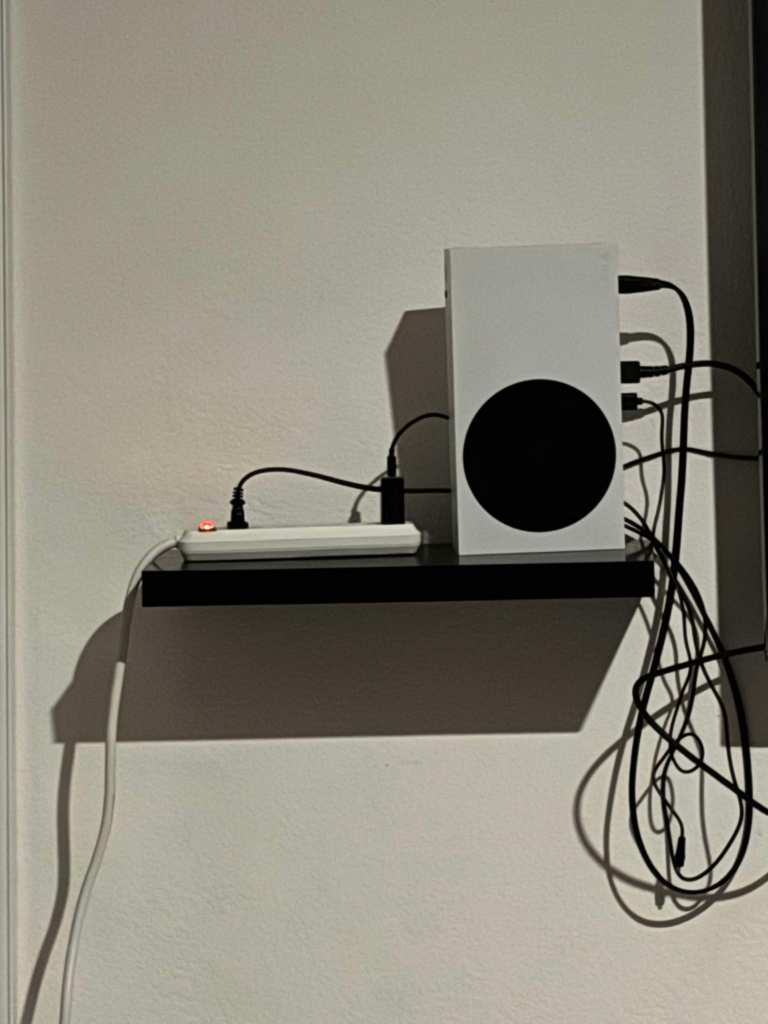
The next time you see a floating shelf displaying someone’s precious collections, be sure to acknowledge the amount of physics and engineering that went into making sure that the shelf is safe!

What’s your take on this? Click below to leave a comment