Have you ever learned about the Mohs scale? Well, I did, recently. It is a way to rank minerals from 1 to 10 by which ones can scratch which, with soft talc at 1 and diamond at 10. But the numbers aren’t evenly spaced, and the jump from 9 (corundum) to 10 (diamond) is much bigger than the jump from 8 to 9. But learning about the scale got me thinking about what makes some materials so much harder than others. Take diamonds, for example. They are the hardest naturally occurring substance on Earth, and I’ve always wondered why!
A diamond seems like a simple gemstone that most people wouldn’t think twice about. But there is a lot of physics and chemistry that goes into making one so hard to scratch. A diamond is one of the hardest materials because it is pure carbon with its atoms locked in place.
Though it looks like a clear, fragile crystal, at the atomic level it’s built like a cage. Each carbon atom bonds to four others, forming a rigid 3D shape called a tetrahedral lattice.
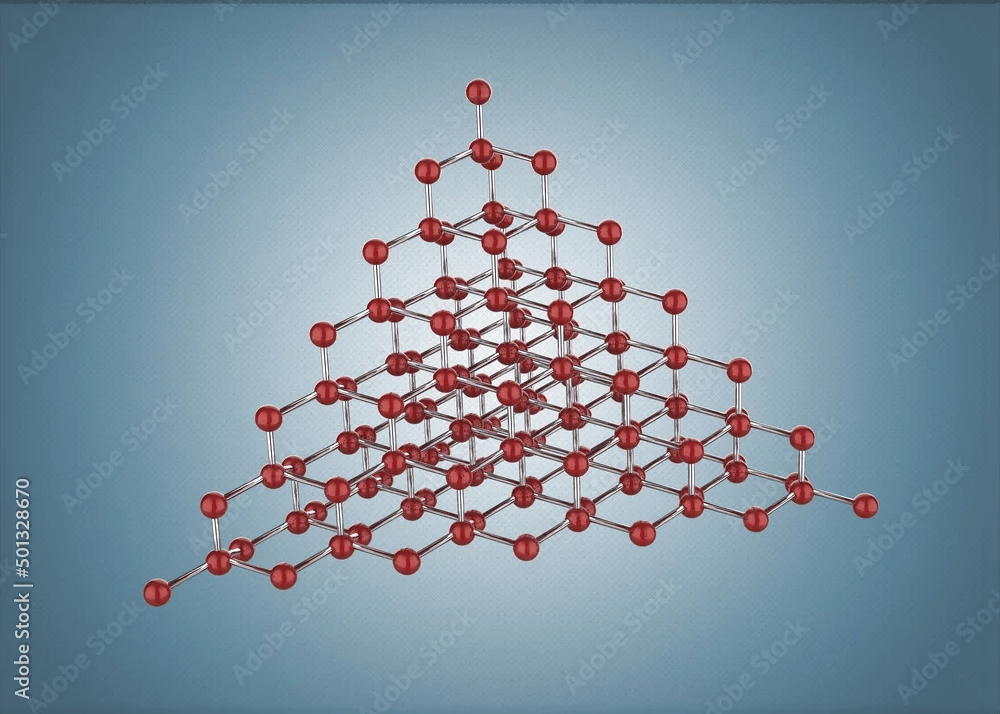
These strong covalent bonds combined with the fact that a diamond can cram more atoms into each cubic centimeter than any other substance makes it the hardest and least compressible material. It’s also very stiff. Its Young’s modulus (a measure of how resistant a material is to stretching or compressing) is about 1,200 gigapascals, or about five to six times as much as steel. You can push on diamond and its atoms don’t move.
This next part surprised me, graphite, the “lead” in a pencil is also pure carbon. The only difference is that the carbon atoms in graphite form layers of sheets that can slide over each other which is why it’s so soft and slippery. In a diamond, every single atom is locked in 3D. So the same element can be one of the softest or one of the hardest solids, it all depends on the structure. That also explains why diamonds are so difficult to create. They form naturally 90 to 125 miles or so below the Earth’s surface in the mantle at around 900 to 1,300°C and around 50,000 times normal sea-level pressure. That much pressure is required to force the carbon atoms into the denser diamond structure. Then volcanic eruptions bring them to the surface. Then they remain diamonds through any conditions we normally find on Earth.
That’s not all, however. Diamonds are also the best conductor of heat, five times better than silver in fact, because the stiff bonds can move vibrations along the lattice so quickly. Also sound moves through a diamond at around 18,000 meters per second.
However, “hardest” doesn’t mean “unbreakable.” Hardness is how resistant a material is to being scratched, and toughness is how resistant a material is to cracking or shattering. Metals are tough because their atoms can shift over one another and bend without breaking. However, a diamond’s atoms can’t slide or bend so when it breaks, it forms cracks. Which makes it hard but brittle. A diamond also has four cleavages directions, planes that run parallel to its octahedral faces. Jewelers exploit these planes to safely split raw diamonds because if you hit a diamond with a hammer at just the right angle, the force runs along one of these planes and the stone splits cleanly or shatters. But if you hit it at other angles, the bonds resist the pressure.
So the next time you see a diamond, keep in mind that its looks aren’t the only dazzling thing about it!

What’s your take on this? Click below to leave a comment